Protestors shut down Israeli Embassy event at Thessaloniki International Book Fair
A planned event organised by the Israeli Embassy at the 21st Thessaloniki International Book Fair on Saturday 10 May was cancelled following a strong public outcry. Publishers, booksellers, and hundreds of activists and solidarity groups came together to protest, sending a clear message: "Literature doesn’t whitewash genocide.” According to BDS Greece, the Hellenic Foundation for Culture (ELIVIP) had agreed to host the event, listing the Israeli Embassy as its official sponsor.
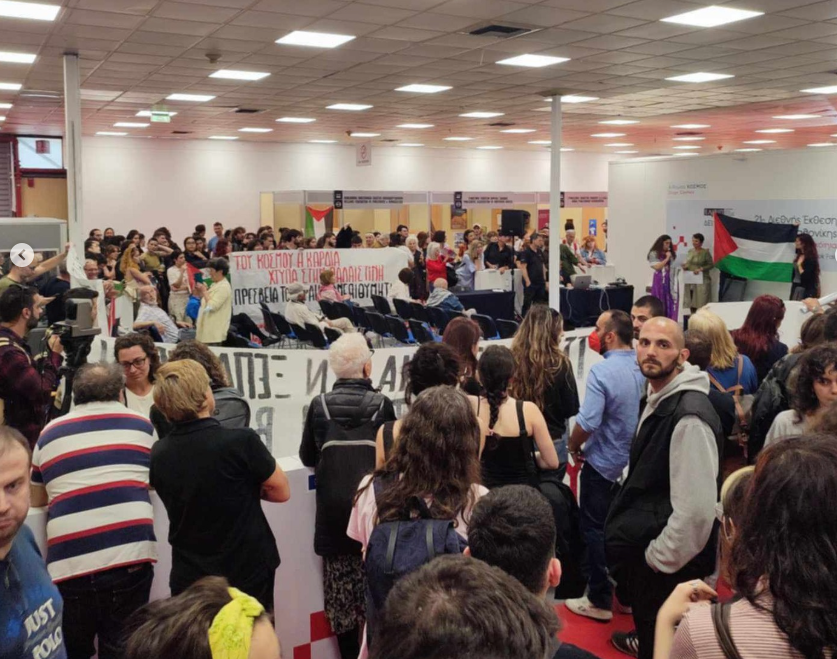
Φωτογραφία από την σελίδα menoume_energoi
The session, titled “Shifting Landscapes of Jewish Literature”, was due to feature Israeli literary critic Oded Wolkstein, Greek journalist Grigoris Bekos, and translator Chrysoula Papadopoulou. Protesters holding Palestinian flags gathered at the fair, opposing what they called an attempt to use literature to sanitise the image of the Israeli state.
The protest was successful. The event was scrapped, making headlines as part of a wider cultural boycott movement. Demonstrators denounced what they saw as the use of a legitimate literary discussion to obscure or excuse crimes committed by Israel, especially in the context of the ongoing war in Gaza.
In a statement, BDS Greece criticised ELIVIP for cooperating with what it called a “genocidal regime”, saying:
“A meaningful literary theme is being used as a tool to whitewash the crimes of the Israeli state. We respect Jewish literature, as we do all cultural voices that speak of humanity and freedom. But we reject any attempt to turn books into a smokescreen for state violence.”
Key demands included:
- An end to the normalisation of Israel’s presence at cultural events while it commits crimes against humanity.
- Immediate cancellation of the event and a halt to any collaboration with the Israeli Embassy.
- A full stop to all cultural and academic cooperation with the Israeli state.
- A platform for Palestinian artists, writers, and intellectuals whose voices are consistently excluded.
The protest was backed by a wide range of Greek publishers and collectives. In a public letter titled “Literature Doesn’t Whitewash Genocide”, they expressed outrage at the embassy’s involvement:
“How can literature serve as a fig leaf to hide atrocities? How many books does it take to gloss over genocide? How many pages can erase bombs falling on humanitarian aid ships?”
The statement listed the death toll from recent Israeli military actions, including thousands of civilians and children, the destruction of hospitals and refugee camps, and the ongoing blockade that has left many Palestinians starving. It condemned the Greek state’s complicity and support for Israel’s actions.
The list of signatories included dozens of publishers, bookshops, and associations such as the Panhellenic Federation of Publishers and Booksellers, and the Booksellers and Publishers Association of Athens.
As the event was about to begin, protesters gathered at Pavilion 14 of the book fair, waving banners and chanting slogans like “Freedom for Palestine” and “Stop the Genocide.” Soon after, the organisers confirmed that the event would not go ahead. BDS Greece called it “a victory for solidarity and resistance against the normalisation of genocide.”
Their statement concluded:
“At a time when Israel is committing genocide in plain sight, no cultural activity can serve as an excuse. No book, no institution, no art form should help cover up crimes against humanity. The cancellation of this event is a small but significant step in the international campaign for a cultural boycott of apartheid, occupation, and genocide.”
“Culture belongs to the people – not to those who carry out massacres.”
Insraeli scheduled speaker speaks of “censorship”
Oded Wolkstein, the Israeli literary critic who was scheduled to speak at the event, told Kathimerini newspaper that he saw the cancellation as a form of censorship. He said he wasn’t involved in the decision to cancel but acknowledged that it became logistically impossible to proceed.
“I recognise the right to protest,” he said, “and I even go beyond that. I reject the idea that literature can or should exist in a vacuum, detached from the world’s problems.”
He added that critics of the event were wrong to equate all Israeli culture with the current Israeli government:
“This view ignores Jewish literature’s long tradition of dissent, resistance, and imagining alternatives. If protesters wanted dialogue, I would have welcomed the chance to tell them – without trying to ruin their mood – that I am not an emissary of Netanyahu’s government.”
Wolkstein said he believes the current war is driven by “messianic delusions” and should end immediately. He also referenced the October 7th attacks, calling them a “horrific massacre” that, in his view, cannot be justified by any political context – implicitly dismissing decades of Israeli occupation and apartheid as irrelevant to understanding Palestinian resistance.
______________________________________________
Are you seeking news from Greece presented from a progressive, non-mainstream perspective? Subscribe monthly or annually to support TPP International in delivering independent reporting in English. Don’t let Greek progressive voices fade.
Make sure to reference “TPP International” and your order number as the reason for payment.
Σε χρειαζόμαστε
Το ThePressProject είναι το μοναδικό μέσο ανεξάρτητης, ερευνητικής και αποκαλυπτικής δημοσιογραφίας που στηρίζεται αποκλειστικά στις μικρο-δωρεές των επισκεπτών του. Πιστεύουμε ότι η πληροφορία πρέπει να είναι διαθέσιμη σε όλους και για αυτό δεν κλειδώνουμε κανένα κομμάτι της ύλης αλλά για να παραχθεί το πρωτογενές υλικό που θα βρείτε εδώ χρειαζόμαστε την υποστήριξή σου. Αν δεν πληρώσουμε εμείς για την ενημέρωσή μας, θα την πληρώσει κάποιος άλλος (και αν δεν είσαι ο Μαρινάκης μάλλον δεν έχεις τα ίδια συμφέροντα). Μάθε πώς
- Κάνε κλικ για να σχολιάσεις
Πολιτική Σχολιασμού