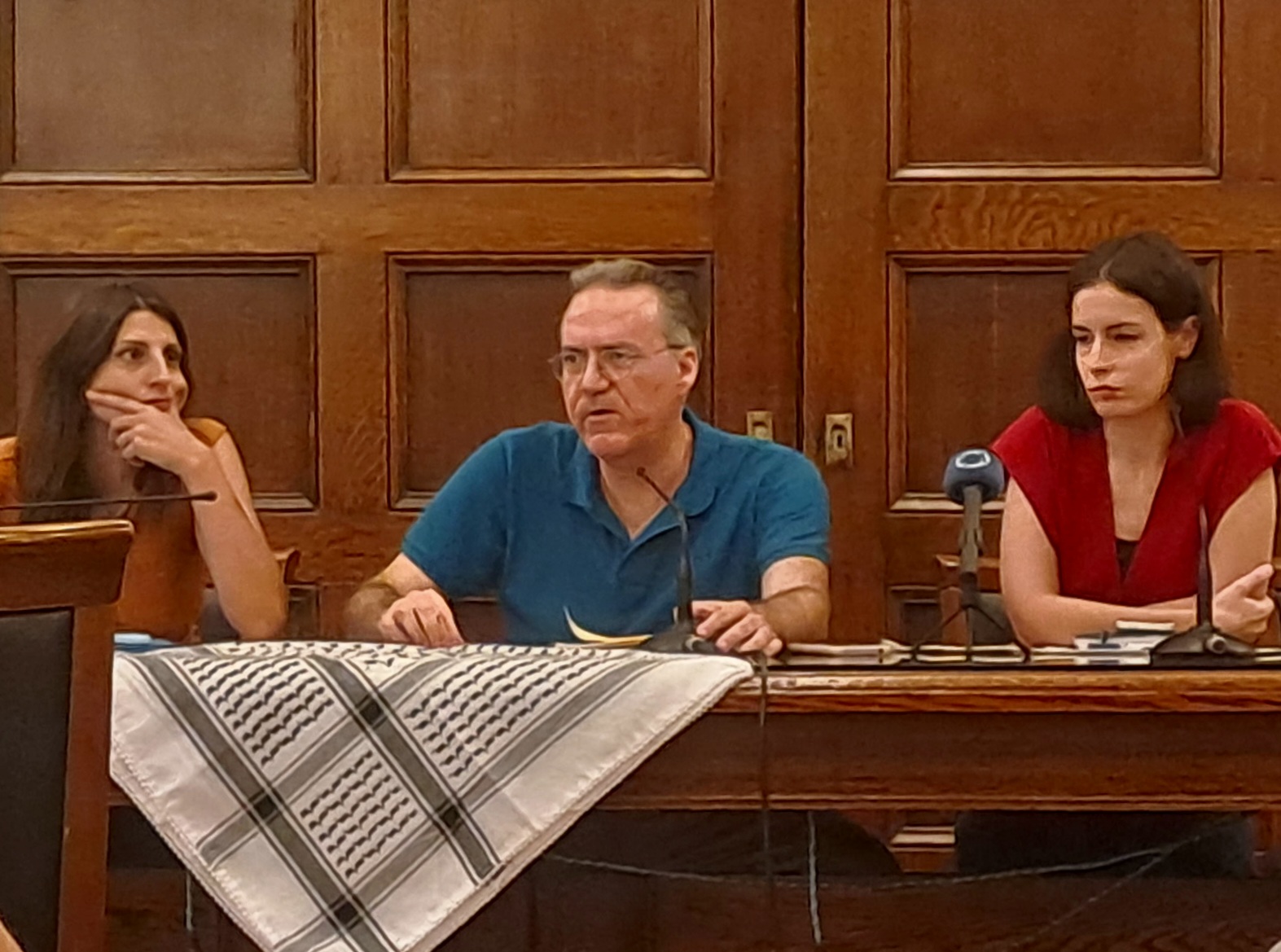
The lawyers stressed that a central element of Israel’s genocidal policy is the attempt to dismantle the Palestinian legal system: bombing its buildings, murdering and imprisoning lawyers, and leaving more than 11,000 Palestinian prisoners without legal representation or basic rights. Palestinian colleagues described to them a ‘parallel war in prisons and detention centres’ while Israeli settlers seize land ‘house by house, alley by alley’. Yet they also expressed certainty that ‘Palestine is the future’. The three Greek lawyers pledged to stand by them.
‘They are not alone’
With a black-and-white keffiyeh – a gift from the Palestinian lawyers – placed on the desk before them, the delegation shared both their evidence and their personal impressions from the occupied territories.
Anastasia Stavropoulou began: ‘Our main goal was to convey the message, which I believe is crucial for the Palestinian struggle everywhere – in Palestine and in the diaspora – that they are not alone. Our governments do not represent the peoples who stand in solidarity with them.’
Interrogations before departure
The lawyers also described ‘strange control procedures that felt like interrogations’ at Athens’ Eleftherios Venizelos airport before boarding their flight. They were questioned in detail about their private lives and the purpose of their trip. Stavropoulou said the individuals questioning them were not Greek citizens but Israelis, likely linked to intelligence services operating on Greek soil.
Matsouka added: ‘It would be very interesting to know who these employees at the airport are, on what basis they operate inside Greece, and what cooperation exists between the Greek and Israeli states that allows this kind of “special treatment”.’
Meeting with the Palestinian Bar
In Ramallah, the delegation met the Palestinian Bar Association president, Fadi Abbas, secretary general Amjad Shilleh, and board members Zeina Jallad, Malik Alouri, and Anas Kisswani. They described to their Greek colleagues the conditions facing Palestinians – particularly lawyers – in the West Bank, Jerusalem, and Gaza.
While Israel’s deliberate killings of doctors and journalists are widely known, the systematic targeting of lawyers has drawn less attention. ‘In Gaza, a significant part of those targeted since the beginning of the genocide are lawyers,’ Stavropoulou said. Nearly 300 lawyers there have been executed or “disappeared”. In the West Bank, thousands of lawyers face beatings, surveillance, arrests on fabricated charges, and administrative detention. In 2023, the Bar Association building in Gaza was bombed. ‘There is nothing left of institutional justice in Gaza,’ she said.
11,000 prisoners held without trial
On 31 August, accompanied by Abbas, the Greek delegation met Commissioner Raed Abu Alhomos of the Palestinian Ministry of Prisoners’ Affairs. He reported that Israel currently holds 11,000 Palestinians from the West Bank and Jerusalem in 15 prisons. Of these, 3,650 are in indefinite administrative detention without charge, 49 are women, and 450 are children. Prisoners are subjected to torture and deprived of rights and basic conditions.
‘Inside Israeli prisons, torture is the norm,’ said Stavropoulou. ‘Even basic things such as access to newspapers or paper and pencil were won only after many struggles – and all of this was stripped away after 7 October 2023.’ Since then, prisoners have been denied clothing, mattresses, and food, with each losing on average 25 kilograms in two years. At least 76 detainees have died ‘under unspecified circumstances’. The Red Cross has been barred from visiting, concealing the scale of abuses.
She added bitterly: ‘In any civilised society, access to a lawyer would be a given. But in the apartheid regime imposed by Israel, even this is not respected.’ In recent years, Israel has even banned communication between lawyers and clients, or allowed it only under humiliating restrictions. Last July, the Bar president himself was prohibited from practising in Jerusalem. In Jerusalem’s Bar Association elections, Israeli forces intervened directly to disrupt the process.
Genocidal intent
‘These actions show clearly the intent to eliminate Gaza’s legal system – and with it, Palestinian society,” Stavropoulou argued. ‘It is another piece of evidence proving genocidal intent: to destroy every element of Palestinian social and political existence, including justice.’
She concluded: ‘If there is ever a humanity with a moral compass, it will honour these lawyers as witnesses and servants of justice. We conveyed not just words of solidarity but also practical steps – including a proposal to twin the Athens and Palestine Bar Associations, as Paris has already done.’
Her voice broke as she described daily life: ‘Roads blocked at gunpoint, quotas on water and food, lack of medicine, constant threats. This is not only genocide, but apartheid – a racist regime of daily violation of basic human rights. It is also a blood regime that fuels Israel’s economy and war industry.’
Settler land theft
Lawyer Anastasia Matsouka underlined: ‘In Gaza today the moral standard of humanity is being judged. That is why we must take a clear position.’
She described how settlers seize Palestinian homes: ‘They identify a target house, place explosives at the door, break in violently, assault the family, even children. This happens mostly at night.’ Families are dragged to prisons, while settlers – often soldiers rotating in and out – take over. ‘These houses become watchtowers, strongholds, stepping stones to seize the next block,’ she said.
Thanasis Kampayiannis added: ‘The battle for Palestine is fought house by house, alley by alley. We visited one area where the court ruled in favour of settlers for 15 houses. You could see it at once: settlers had reinforced steel doors, Palestinians had ordinary village doors. It is systematic land theft.’
The prison of a people
Kampayiannis described checkpoints as ‘removing human status’ and resembling ‘a zoo, with Israelis as beast tamers opening and closing turnstiles at will’.
‘We went to visit the prison of the Palestinian people,’ he said. ‘This trip depended entirely on whether Israel would let us in. Next time, we may not be allowed.’
He stressed that Palestinians face a state determined to annul their collective existence – in Gaza through extermination, in the West Bank through apartheid, and in Jerusalem through fragmentation. Justice itself is shattered: different courts try crimes depending on whether the perpetrator or victim is Israeli or Palestinian. If a Palestinian kills an Israeli, they face a special Israeli military court in the West Bank; no Palestinian lawyer can defend them.
‘At a time when Israel justifies its genocide in Gaza with the hostages of Hamas, more than 11,000 Palestinians – men, women, and children – are themselves hostages of Israel. Held without trial, tortured, starved, stripped of rights. Yet in the “civilised West”, we do not call them hostages,’ Kampayiannis said. ‘It is our responsibility to rethink words like “terrorist” and “hostage”.’
The meeting ended with a promise of continued cooperation between Greek and Palestinian lawyers. Palestinians, the delegation reported, repeatedly emphasised one demand: sanctions against Israel, and the use of international legal tools – including the Genocide Convention and the Rome Statute – to end Greece’s collaboration with the occupying state.
______________________________________________
Are you seeking news from Greece presented from a progressive, non-mainstream perspective? Subscribe monthly or annually to support TPP International in delivering independent reporting in English. Don’t let Greek progressive voices fade.
Make sure to reference “TPP International” and your order number as the reason for payment.