TPP in Chios: Moroccan detainee denies charges, says Coast Guard rammed refugee boat
The Moroccan survivor of the deadly shipwreck off Chios, who is accused of migrant smuggling and causing the deaths of 15 people, has pleaded not guilty to all charges. He is expected to testify before an investigating judge and a prosecutor on Saturday afternoon.
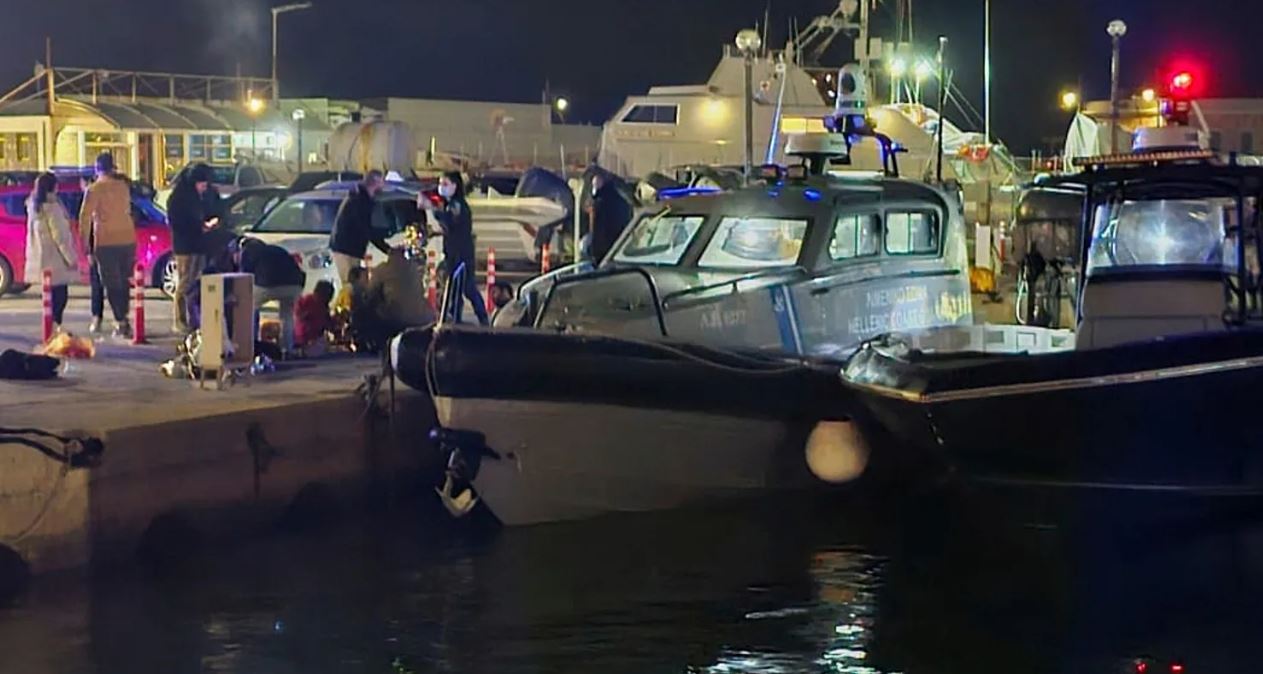
Reporting from Chios: Nektaria Psaraki
According to reliable information obtained by The Press Project, which is reporting from Chios, the accused maintains that he was a passenger, not the operator of the boat, and that the collision occurred when a vessel of the Greek Coast Guard suddenly appeared in front of them in the middle of the night, turned on its lights and struck the inflatable head-on.
‘It was as if it cut off our path. It almost ran us over,’ he says, echoing accounts given by other survivors.
Despite this, his detailed version of events does not appear in the official documents of the preliminary investigation. Nor do the complaints of other survivors that the Coast Guard rammed their boat. Instead, the focus of the pretrial process appears to have been placed on alleged contacts with trafficking networks and on the speed of the refugee vessel.
Charges and denial
The Moroccan survivor is expected to appear before the Chios criminal court investigator at 6pm. He faces charges of migrant smuggling for profit in a manner that endangered lives, causing a shipwreck resulting in multiple deaths, disobedience for allegedly failing to comply with Coast Guard signals, and illegal entry into the country.
According to TPP sources, he categorically denies all accusations. He states that he paid for his passage, was seated in the middle of the boat, and that the person operating it was of medium height and wearing a mask. He adds that the smugglers were distinct from the driver and that those organising the crossing in Turkey spoke Turkish. He stresses that he does not recognise the driver, noting that he himself is 1.92 metres tall.
‘They almost ran us over’
Describing the collision, the accused says that the refugee boat was sailing very close to the Greek coast when the Coast Guard vessel appeared abruptly in front of them.
‘I imagine it approached us with its lights off, because we did not see it. Suddenly it turned on its lights and crashed into us. It was as if it cut off our own path,’ he told TPP, a description consistent with testimonies given by survivors to health workers, who reported that the Coast Guard rammed them.
According to the same information, the accused reenacted the incident during questioning, indicating that the refugee boat was travelling straight towards Greece when its course was suddenly interrupted from the side by the Coast Guard vessel, which accelerated towards them.
‘From the impact, the front of our boat was crushed by the Coast Guard vessel. It almost ran over us, and everyone who was there died,’ he said.
This account, however, is absent from his official pretrial statement.
Gaps and contradictions in the record
In his formal statement during the preliminary investigation, the Moroccan survivor is recorded as saying: ‘I know nothing about what they are accusing me of. We were at sea for about 45 minutes when I suddenly felt an impact and lost consciousness momentarily. When I came to, I saw people unconscious in the sea while I was still on the boat. The next moment I saw a Coast Guard boat trying to pick us up.’
The statement omits any description of how the collision occurred.
It is also notable that his arrest was announced to the media at 5pm, just half an hour after he was identified by one of two witnesses, and five hours before his actual arrest, which reportedly took place at around 10pm.
Testimonies from other survivors are similarly absent from the official file. According to TPP information, during the preliminary investigation conducted inside the hospital a few hours after the shipwreck, survivors were still wet, injured and in a state of severe psychological distress. Their descriptions of the collision were recorded in vague terms, such as ‘I saw a white light and felt an impact’ or ‘it was like an explosion’.
Only one survivor’s statement explicitly notes a warning cry: ‘I was standing with my head down when I heard others shouting “it’s coming, it’s coming”, and then I felt the impact.’ This is the sole official testimony that clearly suggests the Coast Guard vessel headed towards and struck the refugee boat.
The Moroccan survivor’s description of the driver as masked and of medium height is independently corroborated by another refugee, despite the fact that the two had no contact with one another and no legal representation at the time. The majority of witnesses have stated that they do not recognise the accused as the driver.
Focus on ‘targets’ and speed
In their statements, Coast Guard officers reportedly focused heavily on the speed of the refugee boat, consistent with their official narrative that it rammed the patrol vessel at high speed. Refugees are referred to as ‘targets’ more than ten times in Coast Guard testimony.
Officers claim that ‘the speedboat smuggler did not comply with sound and light signals but instead reversed course and performed dangerous manoeuvres with the aim of ramming’, despite survivors insisting that there was no siren or warning, only a sudden bright light moments before the fatal collision.
In light of these discrepancies, serious questions arise about the conduct and scope of the investigation. Why do the official statements of the accused and witnesses differ from their reported accounts? Were asylum seekers treated as ‘targets’? Was the Coast Guard acting under a rescue mandate or a deterrence operation? Were there recording cameras on board beyond thermal imaging systems? Will the phone records of on-duty Coast Guard officers be examined?
These questions remain unanswered as the Moroccan survivor prepares to testify.
______________________________________________
Are you seeking news from Greece presented from a progressive, non-mainstream perspective? Subscribe monthly or annually to support TPP International in delivering independent reporting in English. Don’t let Greek progressive voices fade.
Make sure to reference “TPP International” and your order number as the reason for payment.
Σε χρειαζόμαστε
Το ThePressProject είναι το μοναδικό μέσο ανεξάρτητης, ερευνητικής και αποκαλυπτικής δημοσιογραφίας που στηρίζεται αποκλειστικά στις μικρο-δωρεές των επισκεπτών του. Πιστεύουμε ότι η πληροφορία πρέπει να είναι διαθέσιμη σε όλους και για αυτό δεν κλειδώνουμε κανένα κομμάτι της ύλης αλλά για να παραχθεί το πρωτογενές υλικό που θα βρείτε εδώ χρειαζόμαστε την υποστήριξή σου. Αν δεν πληρώσουμε εμείς για την ενημέρωσή μας, θα την πληρώσει κάποιος άλλος (και αν δεν είσαι ο Μαρινάκης μάλλον δεν έχεις τα ίδια συμφέροντα). Μάθε πώς
Σχόλια
- Κάνε κλικ για να σχολιάσεις
Πολιτική Σχολιασμού