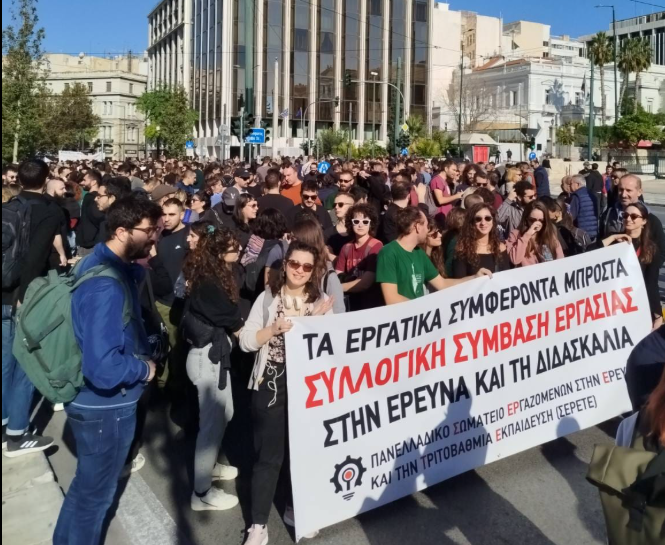
According to a statement by the union, the NTUA administration is seeking to amend Article 2 of the Funding and Management Guide of the university’s Special Research Fund Account (ELKE), which sets out the institution’s basic ethical principles and research mission. For nearly three decades, this provision has explicitly prohibited NTUA’s participation in research programmes of a military nature or in projects funded by international military coalitions, including NATO.
SERETE said the proposed amendment was approved on Wednesday by the ELKE Senate Research Committee through an urgent procedure, with the chair casting a double vote. The proposal is expected to be submitted to the university’s Senate for final approval on Friday.
Research and university workers have expressed strong opposition, arguing that such a change would alter the character of academic research and the public mission of the university. In its statement, SERETE said it rejects any direction of research towards war, surveillance or the arms industry.
The union said the existing ban on war-related research is rooted in the legacy of the Polytechnic’s role in struggles for freedom and peace, as well as in pressure from past student and anti-war movements. It argued that this framework has been steadily undermined in recent years and that research linked to military and dual-use technologies has already expanded at NTUA.
SERETE also referred to previous mobilisations by students and staff against research programmes related to war, surveillance and border control, as well as to collaborations with military bodies. It warned that, amid wider political and economic developments in Europe, there is growing pressure to normalise military-oriented research and make it a central source of funding for universities.
According to the union, the proposed regulatory change aligns NTUA with broader European and market-driven priorities that promote war preparation and a war economy, while public funding for research and higher education continues to decline. SERETE said this leaves many researchers in precarious employment conditions and increases dependence on externally funded projects.
Describing the proposed amendment as a serious and worrying development, SERETE criticised what it said was a lack of transparency and the absence of consultation with employee and student representatives. It called for the withdrawal of the proposal and reaffirmed its opposition to any involvement of the university in research related to war or military alliances.
The union announced a mobilisation at NTUA on Friday morning, calling on students and workers to oppose the proposed change and demand research that serves social needs rather than military objectives.
______________________________________________
Are you seeking news from Greece presented from a progressive, non-mainstream perspective? Subscribe monthly or annually to support TPP International in delivering independent reporting in English. Don’t let Greek progressive voices fade.
Make sure to reference “TPP International” and your order number as the reason for payment.