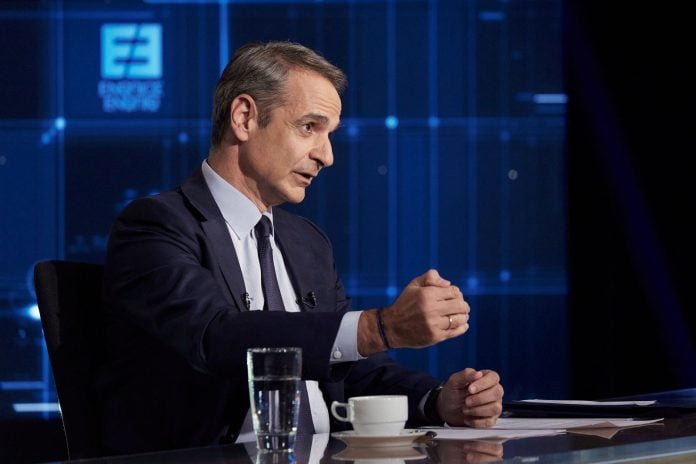
Mitsotakis said the elections would take place in spring 2027, noting that Greece assumes the presidency of the Council of the European Union on 1 July 2027 and arguing that the elections must therefore have already been held.
He said ‘New Democracy’s goal is a single-party majority’, arguing that ‘the country needs a stable government without complicated negotiations for cooperation’. Based on the current positions of the parties, he said, there is no possibility of cooperation, as ‘everyone has ruled out cooperation with New Democracy’.
‘I respect the popular verdict, but the lack of willingness to reach an understanding from the other parties makes it difficult to form coalition governments,’ he said, referring to the possibility of a coalition government with far-right parties.
He also ruled out scenarios under which New Democracy would participate in a coalition government without him as prime minister, saying: ‘Citizens choose not only a party, but also a prime minister. In a prime-minister-centred system, the leadership of the first party is directly linked to the governance of the country.’
The prime minister justified salary increases for metropolitans at a time when the incomes of the poorest sections of society are failing to keep up with austerity and price rises, admitting that this had been a longstanding demand of the Church of Greece. ‘I find it difficult to accept that the salary of a metropolitan, who governs a large metropolis, should be significantly lower than the salary of a mufti,’ he said, mobilising Islamophobic reflexes to justify his decision.
Tempi, wiretapping and urban planning scandals
Referring to the Tempi railway crime, Mitsotakis argued that the government had not protected Kostas Karamanlis, saying that for the first time a government majority had referred one of its ministers to the Judicial Council. He stressed that the case is now before the judiciary, with dozens of defendants, and that only the courts can assign responsibility, despite complaints about the conditions under which the trial is being conducted and the fact that the state is appearing in support of the prosecution against only a small number of defendants.
He spoke of a ‘great urban myth’ surrounding xylene and of an organised attempt to smear both the government and him personally through accusations of a cover-up. He also described the allegations over the backfilling of the crash site as the ‘greatest filth’ he has heard in his political career.
Regarding delays in contract 717, he argued that the existence of administrative delays does not automatically entail criminal liability. He cited the Patras-Pyrgos road project as an example, arguing that delays in public works cannot automatically lead to the criminal prosecution of ministers.
On the wiretapping and Predator spyware case, he spoke of ‘malfunctions’, while passing responsibility to the judiciary and avoiding further comment. At the same time, in an attempt to launder the image of the National Intelligence Service (EYP), he referred to what he described as its important role in managing critical national security issues.
He attributed the new scandal in urban planning to ‘chronic pathologies’, but argued that the government has already launched important reforms, such as the transfer of urban planning services to the Land Registry. He rejected the description of ‘blue scandals’, saying corruption has no party colour and that the current government is the one revealing and confronting such phenomena. He admitted that he would have liked certain changes to have progressed faster, but argued that significant progress has been made in the functioning of the state.
OPEKEPE and the European Public Prosecutor’s Office
Regarding the OPEKEPE scandal, Mitsotakis admitted there had been a significant delay in addressing the problems, saying characteristically: ‘We tried to fix the system from within and we failed.’
He also defended the decision to abolish OPEKEPE and transfer its responsibilities to the Independent Authority for Public Revenue (AADE), arguing that only in this way can full transparency in agricultural subsidies be ensured. He described this intervention as ‘the most difficult reform’ of his seven years in government and expressed certainty that it was the right choice.
Regarding investigations by the European Public Prosecutor’s Office, he argued that the government had not obstructed any procedure, while expressing doubts over whether certain cases have the political dimension attributed to them. Referring to the European chief prosecutor, he said every prosecutor is judged by the results of cases that lead to convictions and not simply by files being sent to the courts.
‘If you ask me, yes, I hope she is wrong, but I cannot say that. Because these cases will be judged by the courts,’ he said.
The prime minister ruled out the possibility of reinstating the 13th salary in the public sector, arguing that a significant part of the relevant demands has already been covered through increases launched by the government. He said not all public servants should be treated as a single category, noting that doctors, uniformed personnel and other professional groups have received targeted increases and additional benefits.
Israel, inflation and criticism from former New Democracy leaders
Mitsotakis defended the ‘strategic relationship’ with Israel, which is committing genocide in Palestine and has attacked Lebanon and Iran, saying: ‘We have a strategic relationship with the state of Israel and our position allows us to criticise Israel if it violates international law. Our country has provided practical support to Gulf countries and this creates the conditions for a substantial upgrade of our position. We are moving purely on defensive initiatives. The Ankara-Israel skirmish is not new. They are more aimed at domestic public opinion. I hope that we will not find ourselves in an unnecessary hotbed of tension.’
He once again attributed the problem of inflation to global turmoil, saying it is fuelled almost exclusively by fuel prices.
Responding to criticism from two former New Democracy prime ministers, Antonis Samaras and Costas Karamanlis, he said both had managed relations with Turkey and knew the complexity of that relationship, as both had met with Erdoğan and also sought to maintain a functional relationship with Turkey.
‘Greece, when it had to do its duty on the SAFE issue, did so and Turkey did not get involved,’ he argued. ‘I am the only Greek prime minister who went to Ankara and directly raised, politely but without retreating from the Greek positions, the issue of casus belli.’
‘I believe that their criticism on this particular issue is unfair,’ he concluded.
Regarding Costas Karamanlis, he said he treats all former leaders of New Democracy with respect, regardless of individual disagreements, and that his stance towards them remains institutional and dignified.
However, he threw down the gauntlet to Samaras, saying: ‘He is a man who comes from the party. The party embraced him again at some point, gave him the opportunity, he became prime minister.’
‘I therefore cannot imagine that ultimately this man will do something that will damage the party that gave him a second chance and made him prime minister. I do not believe that will happen. The issue is not to resolve our personal issues. If Mr Samaras believes what he says about foreign policy, which he did not believe in 2023 because he was a candidate with New Democracy again, there is no room for rapprochement. I hope that reason will prevail and that he will understand that he will harm his reputation if he proceeds with the establishment of a party,’ he said of the former prime minister.
Regarding Maria Karystianou, he admitted that ‘she has significant social and emotional capital because of her personal journey, but I do not know to what extent this can be transformed into political influence.’
Finally, regarding the return of Alexis Tsipras through a new political entity, Mitsotakis avoided taking a position on individuals, noting that this is not an issue he can influence. However, he criticised the SYRIZA government, referring to failures, arrogance and the deception of citizens. He also rejected descriptions by Tsipras’ associates of him as ‘the most honest prime minister of the post-dictatorship period’.
‘I do not know if there is an honesty meter, but what I saw in the SKAI documentary gave me chills,’ he said.
______________________________________________
Are you seeking news from Greece presented from a progressive, non-mainstream perspective? Subscribe monthly or annually to support TPP International in delivering independent reporting in English. Don’t let Greek progressive voices fade.
Make sure to reference “TPP International” and your order number as the reason for payment.